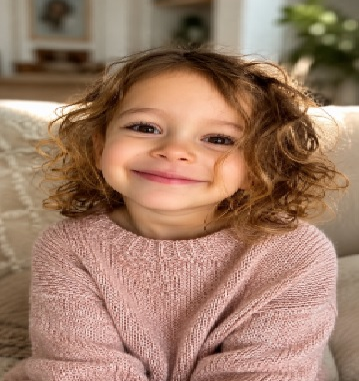
Months later, after interviews, home inspections, and countless meetings, we met four-year-old Lily. She sat quietly in the corner of the playroom, hugging a faded stuffed rabbit as if it were the only thing she trusted. When I sat beside her, she didn’t speak. Instead, she handed me a blue crayon.
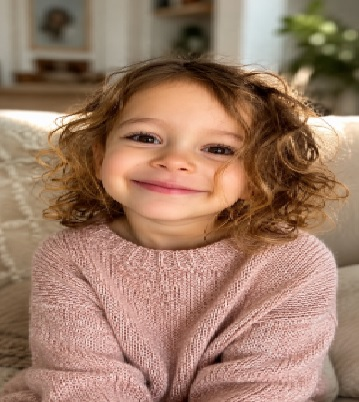
I looked down at it, unsure what she expected.
“Is this for me?” I asked gently.
She nodded once.
On the floor between us lay a large sheet of paper covered in colorful scribbles. A yellow sun floated in one corner. A crooked red house stood in the middle, surrounded by flowers that looked more like tiny explosions than blossoms.
“There’s still room,” I said.
Without speaking, Lily pointed to the empty sky.
I drew a small blue bird.
She watched carefully, then picked up a green crayon and added another bird beside mine.
For the first time, the corners of her mouth lifted into the faintest smile.
It lasted only a second.
But it was enough.
As we left the adoption agency that afternoon, my wife, Anna, squeezed my hand.
“She chose you,” she whispered.
I shook my head.
“No.”
“She invited us into her world.”
The paperwork continued for another six weeks.
Those were the longest weeks of our lives.
Every phone call made our hearts race.
Every email felt important.
Then, on a rainy Thursday morning, our social worker called.
“She’s ready to come home.”
Neither Anna nor I said anything.
We simply cried.
Lily arrived carrying one small backpack, her stuffed rabbit, and a cardboard box containing everything she owned.
Inside were two sweaters, three picture books, a pair of worn sneakers, and a tiny blanket decorated with faded stars.
“That’s all?” Anna whispered.
The social worker nodded.
“She likes routines.”
“She wakes up early.”
“She’s afraid of thunderstorms.”
“And…”
She hesitated.
“If she hides food, don’t be alarmed.”
“She isn’t being dishonest.”
“She just hasn’t learned yet that there will always be another meal.”
That evening, while unpacking her backpack, I discovered three crackers wrapped carefully inside a napkin.
I quietly placed them back.
The next morning, I packed her lunch with twice as much food as she could possibly eat.
When she returned from preschool, the extra sandwich was still untouched.
“I saved it,” she explained nervously.
“For tomorrow.”
I opened the refrigerator.
“You never have to save food here.”
“There will always be more.”
She stared at the shelves filled with fruit, milk, vegetables, leftovers, and yogurt cups.
“Always?”
“Always.”
She looked unconvinced.
Trust, I realized, couldn’t be promised.
It had to be proven.
Again and again.
For months, Lily hardly spoke.
She answered most questions with nods or shrugs.
She never cried loudly.
Instead, she disappeared.
Whenever something upset her, we would find her sitting quietly in the closet with her rabbit.
Our pediatric therapist suggested patience.
“She learned that adults leave,” she explained.
“Now she’s waiting to see whether you will.”
One afternoon, Anna accidentally raised her voice after dropping a heavy pot in the kitchen.
It wasn’t directed at Lily.
Still, Lily immediately ran upstairs and hid beneath her bed.
I crawled onto the floor until I could see her frightened eyes.
“You’re not in trouble.”
Silence.
“Nobody’s angry at you.”
More silence.
Finally, a tiny voice asked,
“Are you sending me away?”
My heart cracked.
“No.”
“What if I make mistakes?”
“You will.”
“What then?”
“We’ll help you fix them.”
“And then?”
“We’ll still love you.”
She crawled out slowly.
That was the first time she hugged me.
As the years passed, Lily slowly traded fear for confidence.
She loved painting more than anything.
Every birthday, every holiday, every rainy afternoon somehow ended with colorful fingerprints covering paper, tables, and occasionally the dog.
Her elementary school art teacher once called us.
“She has remarkable talent.”
More importantly, she has remarkable kindness.
Whenever another child struggled with a drawing, Lily quietly sat beside them until they smiled again.
When she turned twelve, Lily asked us a question we knew would eventually come.
“Why didn’t my first parents keep me?”
Anna reached across the table.
“We don’t know every detail.”
“But we do know one thing.”
“What?”
“None of it was your fault.”
Lily looked down.
“I used to think maybe I cried too much.”
“You were a baby,” I said.
“Babies are supposed to cry.”
“Maybe I wasn’t lovable.”
Anna immediately shook her head.
“The day we met you…”
“You handed Dad a blue crayon.”
Lily laughed softly.
“I remember.”
“So do I.”
“That tiny blue crayon changed our lives.”
Years passed faster than we expected.
The quiet little girl who once hid crackers in her backpack grew into a confident young woman with paint-stained hands and endless curiosity.
She earned a scholarship to study fine arts.
Her graduation exhibition featured enormous murals celebrating families in every imaginable form.
One painting stopped nearly every visitor.
It showed a frightened little girl sitting alone in a gray room.
A single blue crayon rested beside her.
Across the canvas, color slowly spread as two adults sat beside her—not pulling her toward them, not demanding a smile, simply waiting until she was ready.
The painting was titled:
The First Color of Home.
It won first prize.
During her acceptance speech, Lily said something I will never forget.
“People often think adoption begins when papers are signed.”
“For me, it began when someone accepted a blue crayon from a child who didn’t know how to ask for friendship.”
A few years later, Lily opened her own community art studio.
Children came from every background—some from foster care, some from difficult homes, others simply looking for a safe place after school.
No one was turned away.
Near the entrance stood a glass jar filled with hundreds of blue crayons.
Visitors often asked why.
Lily always smiled before answering.
“Because one blue crayon gave me a family.”
Last spring, while helping organize the studio, I found an old cardboard box tucked away in a storage closet.
Inside lay the faded stuffed rabbit she had carried everywhere as a child.
Its fur was thin.
One ear had been sewn back on several times.
I picked it up and smiled.
Lily noticed.
“I could never throw it away.”
“You don’t have to.”
She held the rabbit for a moment before placing it on a shelf overlooking the art room.
“It reminds me where I started.”
Later that afternoon, a frightened little boy arrived for his first art class.
He stood silently by the door, refusing to come inside.
Lily walked over, opened the familiar glass jar, and held out a single blue crayon.
She didn’t ask any questions.
She didn’t rush him.
The boy looked at the crayon, then slowly took it.
I watched from across the room as they sat together on the floor, drawing birds in a bright blue sky.
In that moment, I realized something extraordinary.
The greatest gift we had ever given Lily was not a house, a bedroom, or even our last name.
It was the certainty that she belonged.
And now, with one simple blue crayon, she was giving that same gift to someone else.
Love has a remarkable way of traveling through generations.
Sometimes it begins with grand gestures.
Sometimes it begins with a quiet child, a faded stuffed rabbit, and a blue crayon placed into the hand of a stranger who would soon become family.