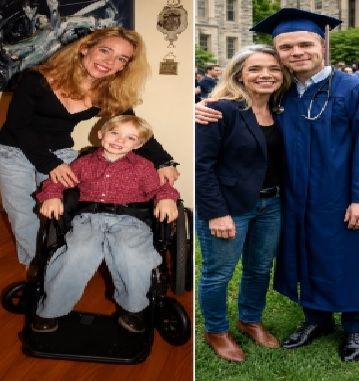
The day my son was born should have been the happiest day of my life.
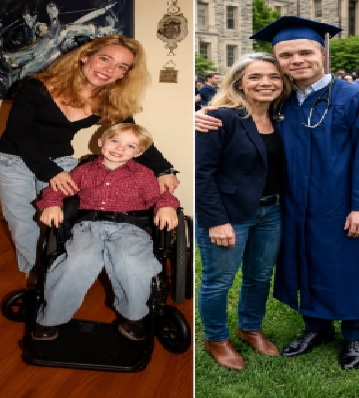
Instead, it became the day everything I believed about love was tested.
After eighteen exhausting hours of labor, I finally heard my baby’s first cry. The nurses smiled, placed him briefly in my arms, and then, almost immediately, carried him across the room for additional examinations.
Something wasn’t right.
At first, no one would tell me what they were looking for.
Doctors came and went, speaking in quiet voices outside my hospital room.
My husband, Daniel, paced the hallway, asking questions no one seemed ready to answer.
Late that evening, a pediatric neurologist entered with a stack of test results.
She sat beside my bed before saying a single word.
That was when I knew.
“Our son has a rare neurological condition,” she said gently.
“We believe it will severely affect the muscles in his lower body.”
I tightened my grip on the tiny blanket covering my baby.
“What does that mean?”
She hesitated.
“We cannot predict everything.”
“But based on what we know today…”
She looked directly at us.
“…it is unlikely that he will ever walk independently.”
The room fell silent.
I looked at Daniel, expecting him to reach for my hand.
Instead, he stared at the floor.
Neither of us spoke during the drive home a week later.
Our son, Ethan, slept peacefully in the back seat, completely unaware that adults had already begun deciding what his future would look like.
For several weeks, Daniel withdrew into himself.
He stopped talking about baby names, family vacations, and the treehouse he once dreamed of building.
Instead, he buried himself in work.
One evening, while I fed Ethan his bottle, Daniel quietly packed a suitcase.
“What are you doing?” I asked.
He didn’t answer immediately.
Finally, he whispered,
“I can’t do this.”
I thought he meant the sleepless nights.
The hospital visits.
The stress.
“I know it’s overwhelming,” I said.
“We’ll figure it out together.”
He shook his head.
“No.”
“I mean this life.”
“I didn’t sign up for hospitals forever.”
“I didn’t sign up to watch my son suffer.”
I felt the air leave my lungs.
“He hasn’t even had the chance to live yet.”
Daniel looked at Ethan sleeping in his crib.
Then he picked up his suitcase.
“I’m sorry.”
Those were the last words he spoke before closing the front door behind him.
He filed for divorce two months later.
By the time Ethan celebrated his first birthday, his father was living three states away.
He never called.
Never sent birthday cards.
Never asked about doctor’s appointments.
Nothing.
For him, it was easier to disappear than to face uncertainty.
For me, disappearing was never an option.
Every morning began before sunrise.
Physical therapy.
Occupational therapy.
Medical appointments.
Insurance paperwork.
Late-night stretches to keep Ethan’s muscles flexible.
I worked from home as a freelance editor because it allowed me to attend every appointment.
Money was tight.
Exhaustion became normal.
Still, Ethan smiled through almost everything.
At four years old, he asked questions that caught me off guard.
“Mom?”
“Yes?”
“Why doesn’t Dad visit?”
Children have a remarkable ability to ask impossible questions with complete innocence.
I answered carefully.
“Sometimes adults make choices they later regret.”
“Will he regret leaving me?”
“I don’t know.”
“But I promise this…”
“You will never be alone.”
Ethan nodded as though that answer was enough.
In many ways, it was.
As the years passed, doctors continued adjusting their expectations.
Technology advanced.
Therapies improved.
Braces became lighter.
Wheelchairs became more sophisticated.
Although Ethan couldn’t walk independently, he refused to let that define him.
He became fascinated with computers before he turned ten.
By fourteen, he was designing software that amazed professional programmers.
At seventeen, he won a national robotics competition.
At twenty-two, he launched a company developing adaptive technology for people with mobility challenges.
His inventions weren’t just successful.
They changed lives.
Hospitals across the country began using his accessibility software.
Rehabilitation centers adopted his communication devices.
Magazine interviews followed.
Then television appearances.
People admired his brilliance.
Few knew how many nights he had spent practicing coding from a hospital bed.
When Ethan turned twenty-five, his company opened a new research center.
The local newspaper asked to profile him.
The article spread quickly online.
Apparently, it also reached Daniel.
Three days later, I heard an unexpected knock at my front door.
Standing on my porch was the man I hadn’t seen in nearly twenty-five years.
His hair had turned gray.
His shoulders seemed smaller than I remembered.
For several seconds, neither of us spoke.
Finally, he whispered,
“I’d like to see my son.”
The request ignited emotions I thought had disappeared long ago.
“You had twenty-five years.”
“I know.”
“I made the biggest mistake of my life.”
I folded my arms.
“What changed?”
His eyes filled with tears.
“I did.”
I almost laughed.
“Convenient timing.”
He lowered his head.
“I deserve that.”
“But please…”
“I don’t expect forgiveness.”
“I only want one conversation.”
I didn’t answer.
Instead, I gave him Ethan’s business address.
“The decision is his.”
The following afternoon, Daniel arrived at Ethan’s office.
Later, Ethan told me everything.
Daniel stood awkwardly in the reception area until Ethan rolled toward him.
For a long moment, father and son simply looked at one another.
Finally, Daniel spoke.
“I don’t expect you to call me Dad.”
Ethan smiled politely.
“I wasn’t planning to.”
Silence.
Daniel glanced around the building.
“You’ve accomplished incredible things.”
“I’ve been lucky.”
“No.”
“You’ve been extraordinary.”
Ethan leaned back thoughtfully.
“You know…”
“When I was little, I imagined this conversation hundreds of times.”
“What did you imagine I’d say?”
“I imagined asking why.”
Daniel closed his eyes.
“I was afraid.”
“Of me?”
“No.”
“Of failing.”
“I convinced myself leaving would hurt less than watching you struggle.”
Ethan nodded slowly.
“You were wrong.”
“I know.”
“You didn’t avoid pain.”
“You simply handed all of it to Mom.”
Daniel began crying.
Real tears.
Not dramatic.
Not theatrical.
Just quiet regret.
“I’ve wanted to apologize every day.”
Ethan remained silent.
After several minutes, he finally said,
“I can’t give you twenty-five years back.”
“I can’t pretend nothing happened.”
“But carrying anger forever doesn’t help either.”
Daniel looked up.
“So…”
“I forgive you.”
“But forgiveness isn’t the same as rebuilding a relationship.”
“That takes time.”
Over the next year, they met occasionally for coffee.
Sometimes they talked for hours.
Sometimes only minutes.
There were uncomfortable silences.
Awkward questions.
Painful memories.
Trust didn’t magically return.
It grew slowly, if at all.
Then life delivered one final twist.
Daniel suffered a severe stroke.
He survived but temporarily lost much of his mobility.
Rehabilitation became his new reality.
Ironically, the rehabilitation center assigned to his recovery had recently installed adaptive technologies developed by Ethan’s company.
Daniel spent months using equipment his son had designed.
One afternoon, while practicing with a robotic mobility system, he quietly said,
“I spent years believing disability would destroy a life.”
He looked toward Ethan.
“I never realized it would be your strength.”
Ethan smiled gently.
“It didn’t make my life smaller.”
“It simply made it different.”
Years later, people often asked Ethan what inspired his career.
He always answered the same way.
“When people underestimated my future, my mother never did.”
“She believed in possibilities before anyone else could see them.”
At an award ceremony celebrating innovations in accessibility, Ethan invited me onto the stage.
Thousands of people applauded.
He looked at me before speaking.
“When I was born, doctors believed I’d never walk.”
He paused.
“They might have been right.”
“But they never said I couldn’t lead.”
“They never said I couldn’t create.”
“They never said I couldn’t change lives.”
Then he turned toward me.
“My mother never measured my future by what my legs could do.”
“She measured it by what my heart and mind could become.”
The audience stood in applause.
I looked toward the front row, where Daniel sat quietly wiping away tears.
Not because he had been part of Ethan’s success.
But because he finally understood what he had walked away from all those years earlier.
Life has an extraordinary way of revealing the true cost of our choices.
Daniel believed he was escaping a difficult future.
Instead, he missed witnessing twenty-five years of courage, laughter, determination, and unconditional love.
I, on the other hand, gained something far greater than the life I had once imagined.
I watched my son become living proof that a person’s future can never be predicted by someone else’s fear.
Sometimes the greatest miracles are not the ones that change our circumstances.
They are the ones that change the way we see what is possible.
And if there is one lesson our journey taught me, it is this:
Never let someone else’s limits become your child’s destiny.