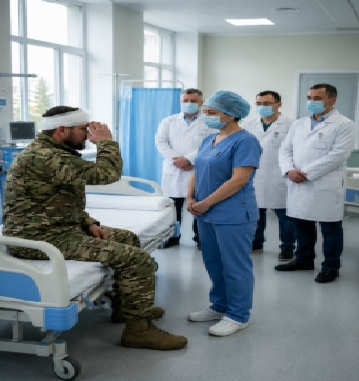
Everyone mocked the new nurse—until a wounded captain saluted her. When they learned who she really was, the entire hospital fell silent.
Her name was Nora Hale.
At least, that was the name stitched onto her fresh white uniform when she walked through the doors of St. Brigid’s Military Medical Center on a rainy Monday morning. She was quiet, composed, and carried herself with a kind of calm that didn’t match the chaos around her.
The hospital, as she quickly learned, had its own hierarchy.
And newcomers were always at the bottom.
Especially quiet ones.
Especially ones who didn’t fight back.
From the very first day, whispers followed her down the corridors.
“She looks too young.”
“Probably got in through connections.”
“She doesn’t even talk much. How is she supposed to handle trauma cases?”
Even some of the senior nurses exchanged glances whenever she passed.
Nora never responded.
She simply worked.
She arrived early.
Stayed late.
Never complained.
And never asked for help.
Her assignment was the emergency surgical wing—one of the busiest sections in the hospital, where military personnel were brought in after training accidents, field injuries, and classified operations.
It was not an easy place to survive.
But Nora didn’t seem to be trying to survive.
She seemed… focused.
Precise.
Almost as if she already knew exactly what she was doing.
Still, the staff didn’t take her seriously.
On her third day, someone “accidentally” left her alone during a critical intake.
On her fifth, a senior nurse publicly corrected her in front of doctors—even though Nora had been right.
On her seventh, a group of orderlies made a joke loud enough for her to hear:
“Wonder how long until she quits.”
Nora said nothing.
But she never forgot anything either.
Then came the day everything changed.
It was late evening when the emergency sirens hit.
Military convoy.
Critical casualties.
Code Red.
The hospital doors slammed open as medics rushed in carrying a man barely conscious, covered in blood and dust. His uniform alone changed the atmosphere instantly.
Captain Elias Mercer.
Highly decorated.
Special operations.
The kind of name that made even experienced surgeons move faster.
The entire wing snapped into action.
But something went wrong immediately.
His vitals were unstable.
Internal bleeding.
Possible spinal trauma.
And the attending surgeon froze when he saw the scans.
“We don’t have time,” someone shouted.
“He’s slipping—”
“Get him to OR NOW!”
Chaos erupted.
And through it all, Nora stepped forward.
Calmly.
Without hesitation.
“I can stabilize him,” she said.
A nearby doctor scoffed.
“You? Step aside.”
But before anyone could stop her, the captain suddenly grabbed her wrist.
Weak.
Barely conscious.
Yet deliberate.
The entire room froze.
His eyes opened slightly.
And he looked at her.
Not like a patient.
Not like a soldier.
But like someone recognizing a memory buried deep.
And then—he did something no one expected.
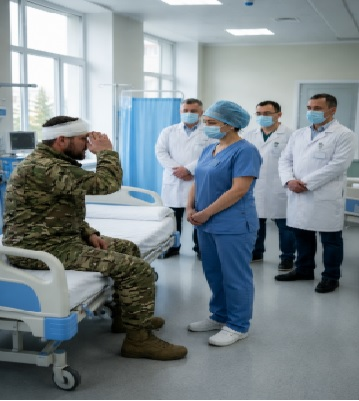
He lifted his trembling hand.
And saluted her.
The room went silent.
Completely.
Even the monitors seemed louder in contrast.
The doctor nearest to them frowned.
“Captain, she’s just a nurse—”
But Mercer shook his head faintly.
His voice was barely audible.
“…She saved my unit.”
Confusion spread instantly.
Nora didn’t react.
Not outwardly.
But something in her eyes shifted—just slightly.
Recognition.
Or maybe resignation.
Then she leaned closer to stabilize him, her movements suddenly sharper, faster, more confident than anything anyone had seen before.
And she whispered something only he could hear:
“You shouldn’t have said that here.”
Within minutes, he was rushed into surgery.
But the damage was worse than expected.
The operation became a battle against time.
And Nora stayed in the OR—not as a nurse observing from the sidelines, but as someone issuing precise instructions that even senior surgeons began to follow.
“Clamp there.”
“No—higher.”
“Stop the bleed first, then stabilize the spine.”
The head surgeon hesitated once.
Nora didn’t raise her voice.
She simply said,
“If you open that cavity before controlling the artery, he dies in under ninety seconds.”
Silence.
Then the surgeon obeyed.
And she was right.
Again.
Hours later, Captain Mercer survived.
Barely.
But alive.
When he was moved to recovery, the hospital expected Nora to finally fade back into anonymity.
Instead, the opposite happened.
A military investigator arrived the next morning.
Then another.
Then the hospital director.
By midday, whispers had turned into panic.
Because the name “Nora Hale” wasn’t appearing in any standard nursing registry.
Her records were incomplete.
Redacted.
Classified.
And inconsistent.
One version said she had trained in civilian hospitals.
Another said she had served in field units overseas.
Another… didn’t exist at all.
No one knew who she was.
Not really.
By evening, Captain Mercer regained enough strength to speak.
And what he said changed everything.
“She was not a nurse,” he told the hospital director.
“She was the field medic assigned to Unit Raven.”
A heavy silence followed.
“That unit was declared inactive three years ago,” someone replied.
Mercer shook his head.
“No.”
“We were never inactive.”
“We were erased.”
The room went cold.
“And she kept us alive when command abandoned us in the northern zone.”
The director slowly turned toward Nora.
“Is this true?”
Nora didn’t answer immediately.
Then she removed her gloves and placed them neatly on the table.
“Yes,” she said quietly.
A collective breath seemed to leave the entire room at once.
The truth unfolded in fragments after that.
Unit Raven had been part of a covert military medical extraction program.
High-risk operations.
No official recognition.
No public records.
When the mission in the northern zone went wrong, communication was cut.
Command ordered withdrawal.
But some medics stayed behind anyway.
Nora was one of them.
She had treated wounded soldiers in conditions no hospital training could prepare anyone for.
She had performed emergency procedures in collapsing shelters under artillery fire.
She had kept people alive who were officially listed as casualties before she ever reached them.
And when the unit was dissolved, she disappeared from military records entirely.
Voluntarily.
Or forcibly.
No one was entirely sure.
So when she walked into St. Brigid’s as a “new nurse,” she wasn’t inexperienced.
She was retired.
Or hiding.
Or both.
And she never corrected anyone.
Until now.
The same staff who had mocked her couldn’t meet her eyes anymore.
The same voices that once dismissed her now whispered in disbelief.
“She worked in combat zones?”
“She saved Captain Mercer?”
“Why didn’t anyone know?”
Nora overheard all of it.
And still said nothing.
Because some people don’t need recognition.
They need distance.
A week later, Captain Mercer insisted on seeing her before discharge.
When she entered his room, he tried to sit up.
She immediately stopped him.
“Don’t,” she said.
“You’re still healing.”
He smiled faintly.
“You always did talk like that.”
She didn’t respond.
He studied her for a moment.
“Why come back to hospitals like this?”
Nora looked out the window.
“For quieter days,” she said.
“But I guess I forgot what quiet really feels like.”
He nodded slowly.
Then he asked the question everyone else was afraid to.
“Are you going to leave again?”
She paused.
“I don’t know.”
For the first time, her voice sounded uncertain.
The hospital eventually issued an official statement.
No details.
No explanations.
Just acknowledgment that Nurse Nora Hale had served in classified military medical operations with distinction.
Suddenly, the same people who mocked her now spoke her name carefully.
Respectfully.
Almost reverently.
But Nora never seemed interested in any of it.
She continued working.
Quietly.
Precisely.
Without asking for attention.
Sometimes, in the late hours of the night shift, staff would see her standing still in the hallway, watching incoming ambulances arrive.
As if listening for something only she could hear.
One of the older nurses once asked her why she never talked about her past.
Nora adjusted her gloves and replied simply:
“Because saving lives is not a story.”
“It’s a habit.”
And then she walked back into the emergency wing, where someone else was waiting to be saved—without knowing that the quiet nurse they had once underestimated had already survived battles most of them couldn’t even imagine.
And that was the moment the entire hospital finally understood:
They hadn’t been working beside an ordinary nurse.
They had been working beside someone who had already earned respect long before they ever met her.