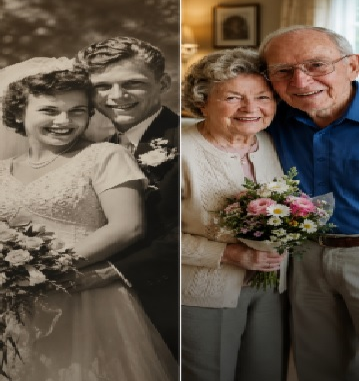
The first bouquet arrived when we had been married for only six months.
It wasn’t expensive. There were no rare orchids or extravagant roses imported from another country. Instead, it was a simple arrangement of white daisies, lavender, and a single red rose placed carefully in the center. Attached to it was a handwritten note in my husband’s unmistakable handwriting.
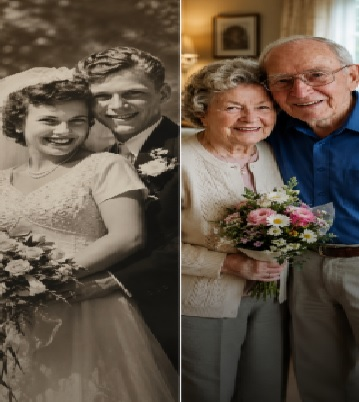
“I hope that no matter how old we become, you’ll always smile when flowers arrive at your door.”
I laughed when I read it because Daniel had never been particularly romantic before we married. He was practical, dependable, and quietly affectionate, the sort of man who fixed broken shelves before anyone asked and remembered exactly how I liked my morning coffee.
But from that Valentine’s Day forward, something remarkable happened.
Every February 14th, without fail, another bouquet arrived.
Sometimes it contained tulips.
Sometimes sunflowers.
Sometimes lilies or carnations.
He never repeated the same arrangement twice.
And every bouquet came with a different handwritten note.
Some notes were funny.
“Congratulations. You survived another year of my terrible singing.”
Others were thoughtful.
“Thank you for choosing ordinary days with me instead of searching for extraordinary ones.”
A few were beautifully simple.
“Growing old beside you has always been my favorite adventure.”
Those flowers became more than a tradition.
They became the quiet rhythm of our marriage.
Even during the difficult years, they arrived.
When Daniel lost his job during the recession, the bouquet was smaller, but it still came with a smile-inducing note.
When I underwent surgery and spent Valentine’s Day recovering in a hospital room, a nurse carried in a vase filled with bright yellow tulips before Daniel even reached my bedside.
When a snowstorm closed most of the town, he somehow walked nearly three miles carrying fresh flowers wrapped inside his winter coat because delivery trucks couldn’t reach our street.
Nothing stopped him.
Not illness.
Not financial hardship.
Not distance.
Not time.
Sixty-three Valentine’s Days.
Sixty-three bouquets.
Sixty-three reminders that love isn’t measured by grand gestures but by promises quietly kept.
Then came the year everything changed.
Daniel passed away peacefully in his sleep just six weeks after our sixty-third anniversary together.
The silence he left behind felt louder than any sound I had ever known.
For months, I couldn’t bring myself to move his reading glasses from the kitchen table.
His favorite sweater still hung behind the bedroom door.
His coffee mug remained on the shelf exactly where he had left it.
People told me time would make the grief easier.
Perhaps they were right.
But time never truly filled the empty chair across from mine.
When February approached, I tried not to think about Valentine’s Day.
After all, traditions end.
People don’t outlive death simply because they made beautiful promises.
On the morning of February 14th, I poured myself tea and settled into the quiet living room.
At precisely 9:15, the doorbell rang.
I assumed it was a neighbor.
Instead, I found a florist standing on my porch.
“Delivery for Mrs. Margaret Lawson.”
“There must be some mistake,” I replied gently.
“My husband…”
The young florist smiled kindly.
“I know.”
He handed me the bouquet anyway.
White daisies.
Lavender.
One red rose.
Exactly like the very first arrangement Daniel had ever given me.
My hands trembled.
Attached to the flowers was a handwritten envelope.
The handwriting wasn’t Daniel’s.
Inside was a note.
“If you are reading this, then my grandfather kept his promise even longer than he believed possible.”
Confused, I continued reading.
“My name is Ethan. I own the flower shop where Grandpa ordered your bouquets every single year. Five years before he passed away, he visited me with a request unlike any I had ever received.”
Tears blurred the page.
“He prepaid one final Valentine’s bouquet to be delivered exactly one year after his death. He said grief needed time before receiving one last surprise.”
I pressed the letter against my chest.
But there was more.
Taped carefully inside the envelope rested a small brass key.
Below it, another sentence.
“Grandpa asked me to tell you that this key opens the place where he kept every promise he never found the right words to explain.”
No address.
No instructions.
Only the key.
The florist noticed my confusion.
“He also asked me to give you this.”
He handed me a faded business card.
On the back Daniel had written only two words.
“The lighthouse.”
Immediately I understood.
Nearly forty years earlier, Daniel and I had discovered an abandoned lighthouse overlooking the northern coastline during an unexpected road trip.
It had become our secret place.
Whenever life became overwhelming, we drove there together.
No anniversaries.
No birthdays.
No special occasions.
Just ordinary afternoons filled with coffee, sea air, and conversation.
After retirement, the property had been purchased by a historical preservation society.
We hadn’t visited in years.
The following morning, I drove there alone.
The caretaker welcomed me after I explained why I had come.
When I showed him the key, his expression changed.
“So… you’re Margaret.”
“You know my name?”
He nodded.
“Daniel visited several times over the last decade.”
Without another word, he led me up the narrow spiral staircase toward the lantern room.
Hidden behind an old wooden cabinet stood a small oak chest secured by a brass lock.
The key fit perfectly.
Inside lay dozens of neatly labeled envelopes.
Every one carried a date.
Some had already passed.
Many had not.
Beneath them rested journals tied together with blue ribbon.
Photo albums.
Concert tickets.
Restaurant receipts.
Pressed flowers.
Train tickets.
Movie stubs.
Little pieces of sixty-three years.
At the very bottom rested another letter.
“My dearest Margaret,”
“If you’ve opened this chest, then I am no longer beside you in the way I always wished to be.”
“You once asked why I never forgot Valentine’s Day.”
“The truth is… I wasn’t celebrating a holiday.”
“I was celebrating the ordinary miracle that someone chose to spend another year beside me.”
“The bouquets were never really about flowers.”
“They were annual thank-you notes disguised as gifts.”
By now, tears fell freely onto the page.
“This chest contains memories I quietly collected because I feared time would eventually steal details from us.”
“Every receipt reminds me of a conversation.”
“Every photograph recalls a laugh.”
“Every pressed flower marks a walk we almost forgot.”
“Memory fades.”
“Love deserves better.”
Then came the sentence that stopped me completely.
“The envelopes dated after today are for the years I hoped you would still keep living.”
With shaking hands, I opened the next envelope.
Inside rested a handwritten suggestion.
“Take Emma to lunch. She misses you more than she admits.”
Emma was our granddaughter.
The following envelope read:
“Plant tomatoes again. Yours always tasted better than mine.”
Another:
“Say yes if someone invites you traveling.”
Another:
“Teach Noah how to bake cinnamon bread before he becomes too old to ask.”
There were twenty-one future envelopes.
One for every year Daniel secretly hoped I might still have ahead of me.
Not instructions.
Not obligations.
Gentle invitations to continue living.
Months passed.
I followed many of them.
I traveled with my grandchildren.
I learned watercolor painting.
I planted another garden.
I volunteered at the local library where children gathered for weekly reading afternoons.
Life never became the same.
It wasn’t supposed to.
But little by little, grief stopped feeling like an endless winter and became something quieter—a season softened by gratitude.
Every Valentine’s Day after that, I returned to the lighthouse carrying fresh flowers.
Not because I expected another surprise.
But because love had taught me its greatest lesson.
Grand gestures fade.
Expensive gifts are forgotten.
Perfect moments pass.
What endures are the promises kept over thousands of ordinary days—the coffee shared before sunrise, the gentle hand held during difficult nights, the laughter over burnt dinners, the silent understanding that grows only through years of choosing each other again and again.
People often ask me whether receiving that final bouquet made saying goodbye harder.
The answer is no.
It made saying thank you possible.
Daniel’s greatest gift was never the flowers themselves.
It was the life they quietly represented.
A life built not on dramatic declarations, but on consistency, devotion, patience, and countless small acts of love repeated faithfully over sixty-three unforgettable years.
And every February 14th, as I place a single red rose beside his favorite photograph, I remember the words from the very first note he ever sent me:
“I hope that no matter how old we become, you’ll always smile when flowers arrive at your door.”
He was right.
Even now, whenever I see fresh flowers waiting on a doorstep, I can’t help but smile—not because they remind me of what I lost, but because they remind me of everything we were fortunate enough to have.