There was only one child in the entire adoption center who didn’t run toward visiting families.
She stayed by the window.
Every single time.
While the other children waved drawings, laughed loudly, or eagerly introduced themselves, the little girl quietly folded paper cranes and lined them up on the windowsill.
“Her name is Nora,” the social worker told us.
“She’s five.”
“Why is she alone?” my wife, Helen, asked.
The woman hesitated.
“Families usually ask about her first.”
“And then?”
“They notice the birthmark.”
A large rose-colored birthmark spread across the right side of Nora’s face, reaching from her eyebrow to the corner of her mouth. It wasn’t frightening. It simply made her look different.
The social worker sighed.
“Some families worry she’ll have a difficult life.”
Others are more honest.”
“What do they say?” I asked.
“They say they want a child who looks… normal.”
The words hung in the air.
Nora kept folding paper without looking at us.
Helen slowly walked over and sat beside her.
“What are you making?”
Without lifting her eyes, Nora answered,
“Birds.”
“They’re beautiful.”
“They’re not finished.”
“What happens when they’re finished?”
“They fly.”
Helen smiled.
“Can you teach me?”
For the first time, Nora looked directly at her.
No excitement.
No expectation.
Only careful curiosity.
That was the moment we became parents.
The adoption process lasted almost nine months.
When Nora finally came home, she treated every kindness as though it might disappear tomorrow.
If we bought her new clothes, she thanked us five or six times.
If we made pancakes, she asked whether they were only for special occasions.
If we hugged her, she stood perfectly still, unsure whether she was allowed to hug back.
One evening, I found her quietly placing her toys into a cardboard box.
“What are you doing?”
She answered without emotion.
“Packing.”
“Why?”
“So it’s easier when you take me back.”
I felt every word like a punch to the chest.
“Nora…”
“We’re not taking you anywhere.”
She looked genuinely confused.
“Not even if I’m difficult?”
“Especially then.”
She didn’t cry.
She simply nodded and unpacked every toy.
School brought new challenges.
Children stared.
Some asked innocent questions.
Others weren’t so kind.
One afternoon, she came home unusually quiet.
Helen eventually found her scrubbing her face in the bathroom mirror.
The skin around her birthmark had turned bright red.
“What happened?”
“I thought maybe it would wash off.”
Helen knelt beside her.
“Who told you it should?”
Nora whispered,
“A boy said monsters always have marks.”
Helen wrapped her in the gentlest embrace.
“No.”
“Monsters hurt people.”
“Your face has never hurt anyone.”
Years later, Nora would tell us that conversation changed the way she saw herself forever.
As she grew older, people gradually stopped seeing the birthmark before they noticed everything else.
She became captain of the debate team.
She played violin beautifully.
She volunteered at an animal rescue center every Saturday.
Whenever new students arrived, she was always the first to welcome them.
“It’s lonely being the new person,” she’d say.
“I remember.”
She carried no bitterness.
Only compassion.
At twenty-three, Nora graduated from medical school.
During her speech, she thanked dozens of people.
Her professors.
Friends.
Patients.
Finally, she looked toward us.
“My parents taught me something no textbook ever could.”
“They showed me that being accepted is wonderful.”
“But being loved before you believe you deserve it changes everything.”
There wasn’t a dry eye in the auditorium.
Two years later, she married Daniel, an architect with an endless sense of humor.
Soon afterward, they welcomed twin daughters.
Watching Nora become a mother was extraordinary.
She kissed every scraped knee.
Listened to every impossible question.
Never rushed bedtime stories.
Sometimes I’d catch her staring at her daughters while they slept.
As though she still couldn’t believe she had a family of her own.
Twenty-five years after we first met Nora, an attorney called unexpectedly.
“There is a certified letter addressed to your family.”
“It was left in our office under very specific instructions.”
The envelope arrived two days later.
Its handwriting was unfamiliar.
Inside was a handwritten letter more than thirty pages long.
The signature at the end stopped Nora’s breathing.
Claire Whitmore.
Her biological mother.
The room fell completely silent.
Nora unfolded the first page.
If you are reading this, then I have reached the end of my life.
There is something I have hidden for twenty-five years because I believed silence was the only way to protect my daughter.
Now the truth belongs to her.
The letter explained that Claire had been nineteen when Nora was born.
She wasn’t ashamed of the birthmark.
She loved her daughter completely.
But someone else wasn’t willing to accept her.
Nora’s wealthy grandfather.
A powerful businessman obsessed with reputation.
According to the letter, he believed the birthmark would become “an embarrassment” to the family’s public image.
He demanded Claire surrender the baby.
When she refused, he threatened to cut off every form of financial support and challenged her parental fitness through expensive legal action she had no ability to fight.
Eventually, exhausted and terrified of losing entirely, Claire agreed to a closed adoption.
But the most shocking revelation came several pages later.
My father told everyone—including the adoption agency—that your birthmark was caused by a rare inherited disorder.
It wasn’t true.
He invented medical concerns to discourage relatives from adopting you.
Then he quietly paid investigators to make sure no member of our extended family could locate you.
I discovered his actions only years later.
By then, the records had been sealed.
I searched anyway.
Every birthday.
Every Christmas.
Every Mother’s Day.
I searched.
Nora slowly lowered the pages.
Tears rolled silently down her face.
Claire’s letter included copies of private journals, legal correspondence, and financial records proving every claim.
There were even canceled checks documenting payments to investigators hired to prevent contact.
But one final envelope remained.
It contained another surprise.
A trust fund.
Years earlier, after breaking ties with her father forever, Claire had quietly built an investment account in Nora’s name.
She never intended it as compensation.
The accompanying note explained why.
Money cannot replace twenty-five birthdays.
It cannot replace bedtime stories, first steps, school concerts, broken hearts, or graduations.
Your parents gave you those.
Nothing I leave behind could ever equal what they gave you.
Please don’t spend this inheritance trying to repay the past.
Use it to build your future.
A month later, Nora made an announcement over Sunday dinner.
She wasn’t keeping the money.
At least not for herself.
Instead, she created a foundation providing reconstructive surgery, counseling, and scholarships for children born with visible facial differences.
Its first building featured no statues.
No portraits.
Only one sentence engraved across the entrance.
Every child deserves to be seen before they are judged.
The foundation grew far beyond anyone expected.
Thousands of families found support there over the following years.
Parents often asked Nora why she had started it.
She always answered the same way.
“Because once upon a time, two strangers looked at a little girl everyone else overlooked.”
“They didn’t see a birthmark.”
“They saw their daughter.”
Sometimes reporters asked whether she felt angry after learning the truth about her biological family.
She would smile thoughtfully.
“Anger lasts only as long as you keep feeding it.”
“I already have something much stronger.”
“What?”
“My family.”
Today, framed on the wall of Nora’s office are two photographs.
The first shows a frightened five-year-old girl folding paper cranes beside a window.
The second was taken twenty-five years later.
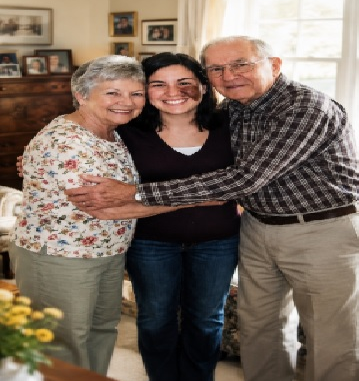
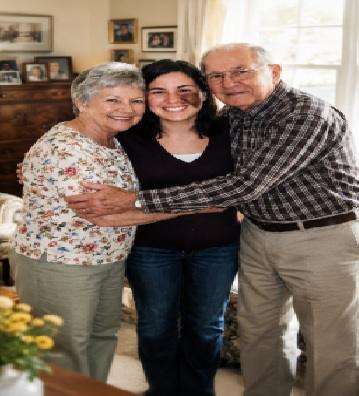
It shows that same little girl—now a confident physician—standing between the two people who chose her long before she believed anyone ever would.
Beside the photographs hangs the final sentence from Claire’s last letter.
The greatest miracle in my daughter’s life was never the family she was born into.
It was the family that chose to love her without hesitation.
Looking at those words now, I know one thing with absolute certainty.
We once believed we had rescued a child who nobody wanted.
The truth was very different.
She had been wanted all along.
She had simply been waiting for the people who would never let her doubt it.