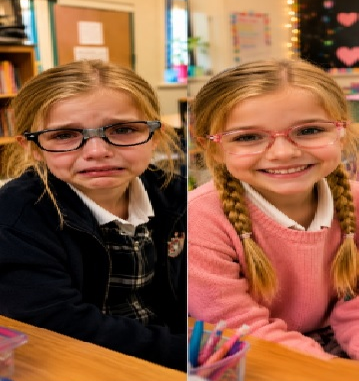
The call came just after eight o’clock.
I had barely finished pouring my first cup of coffee when my phone lit up with the school’s number. At first, I assumed someone had forgotten a lunchbox or that my daughter, Lily, had developed a fever. Instead, I heard the trembling voice of her teacher.

“Mrs. Carter?”
“Yes?”
“This is Ms. Reynolds.”
There was a long pause.
“I… I need you to come to the school immediately.”
My heart skipped.
“Is Lily hurt?”
“No.”
“Is she in trouble?”
Another silence.
Then Ms. Reynolds took a shaky breath.
“Her classmates’ parents are here. Specifically, Oliver’s parents.”
I frowned.
“Why?”
“They’re demanding to speak with you.”
“What happened?”
“You should come. I think it’s better if you hear everything in person.”
The line went dead.
I drove to the school imagining every possible disaster.
Had Lily started a fight?
Broken something expensive?
Said something hurtful?
Nothing prepared me for what I walked into.
The principal’s office was unusually crowded.
Oliver sat quietly in a chair, his head lowered.
His parents stood beside him with tense expressions.
Lily was sitting on a small bench, nervously swinging her feet.
The moment she saw me, she smiled.
“Hi, Mom.”
She looked perfectly calm.
The adults did not.
The principal invited everyone inside.
Before anyone else spoke, Oliver’s father placed a brand-new pair of blue-framed glasses on the desk.
“Did you know your daughter bought these?”
I stared at the glasses.
“No.”
He continued.
“She paid one hundred and twelve dollars.”
I looked at Lily.
“Sweetheart… where did you get that much money?”
She quietly answered.
“I sold my LEGO collection.”
For a moment, I thought I had misunderstood.
“You… sold all of it?”
She nodded.
Every birthday.
Every Christmas.
Every reward for good grades.
For nearly five years she had carefully built that collection.
Hundreds of pieces.
Castles.
Space stations.
Cities.
Entire afternoons had disappeared into those colorful bricks.
She loved them.
“What happened?” I asked gently.
Lily glanced toward Oliver.
“He couldn’t see the board anymore.”
Oliver looked embarrassed.
“He kept squinting.”
“I noticed he copied homework from other kids because he couldn’t read what Ms. Reynolds wrote.”
She continued quietly.
“Some children laughed.”
“I didn’t like that.”
Oliver’s mother slowly wiped away tears.
Lily explained everything.
During recess, Oliver admitted that his glasses had broken almost three months earlier.
His parents had been saving money for replacements while dealing with unexpected medical bills after Oliver’s younger sister required emergency surgery.
Rather than complain, Oliver simply tried to hide how poorly he could see.
Lily had asked how much new glasses cost.
He didn’t know.
That afternoon she searched online with my old tablet.
She found a discount optical shop advertising children’s glasses starting around one hundred dollars.
Without telling anyone, she made a decision.
She photographed every LEGO set she owned.
A neighbor helped her post them online at a community marketplace after believing I already knew.
Within two days every set had sold.
She carefully counted the money.
One hundred and twelve dollars.
Enough.
The following afternoon she convinced Oliver to walk with her after school.
She paid for his eye examination.
Then she insisted the money cover the glasses.
Oliver cried.
The optometrist cried.
Apparently everyone except Lily cried.
Because to her, the decision had been obvious.
“You need your eyes more than toys,” she had simply said.
I looked at my daughter.
“Why didn’t you tell me?”
She shrugged.
“You would’ve bought them.”
“Yes.”
“But then I wouldn’t have helped.”
The room fell silent.
Then Oliver’s father cleared his throat.
“This is why we’re here.”
His expression softened.
“When Oliver came home wearing new glasses, we assumed someone had manipulated him.”
“We were terrified.”
“Our son wouldn’t tell us anything except that Lily wouldn’t let him say no.”
Oliver finally spoke.
“She said friends don’t keep score.”
His mother covered her face.
“We thought maybe another family was trying to embarrass us.”
She looked directly at me.
“We’ve struggled financially this year.”
“We’ve hidden it from almost everyone.”
“Our pride…”
Her voice broke.
“We misunderstood.”
Ms. Reynolds reached into her desk drawer.
“I’d like everyone to see something.”
She removed several folded worksheets.
“These were Oliver’s assignments before yesterday.”
Most answers were incomplete.
Words wandered across the page.
Simple math problems contained careless mistakes.
Then she placed a worksheet completed that very morning beside the others.
Every answer was correct.
Every sentence stayed neatly on the lines.
His handwriting looked completely different.
“I asked him what changed.”
Oliver smiled for the first time.
“I can finally see.”
There wasn’t a dry eye in the office.
Then something even more surprising happened.
Oliver’s father placed an envelope on the principal’s desk.
“We’re not here because we’re angry anymore.”
He looked at Lily.
“We’re here because one little girl reminded two adults what generosity actually looks like.”
Inside the envelope was exactly one hundred and twelve dollars.
Lily pushed it back.
“No thank you.”
He blinked.
“You should have your money back.”
She shook her head.
“If you give it back, then I didn’t really give it.”
The principal quietly laughed through tears.
“You’re making this difficult for adults.”
Lily smiled.
“I know.”
News of what happened somehow spread throughout the school before lunchtime.
Not because anyone intended to make Lily famous, but because kindness has a way of traveling faster than gossip.
By the following week something remarkable had begun.
Students organized a “Share Shelf” in the library where families could anonymously donate school supplies.
Older students collected gently used sports equipment.
Teachers started a fund to help children whose families struggled with unexpected expenses.
No one’s name appeared on donation lists.
No child needed to explain their circumstances.
People simply helped.
Several days later I picked Lily up from school.
She carried a cardboard box.
Inside were LEGO bricks.
Hundreds of them.
Every color imaginable.
“What’s this?”
She smiled.
“My class.”
Each student had contributed a few pieces from home.
Parents added extra sets.
Teachers found forgotten collections in closets and attics.
No one tried replacing exactly what Lily had sold.
Instead, they built something entirely new together.
Attached to the box was a handwritten note signed by every student.
“You taught us that the best things people build aren’t made of plastic bricks.”
“They’re made of kindness.”
Years have passed since that extraordinary week.
The LEGO collection eventually became larger than the original one.
Oliver still wears glasses, though his frames have changed several times as he has grown.
He and Lily remain close friends.
Sometimes people ask whether I was upset that my daughter sold something she loved without asking permission.
The truthful answer is complicated.
As a parent, I wish she had talked to me first.
But as a human being, I realized that day that children sometimes see the world with a clarity adults slowly lose.
They don’t calculate social status.
They don’t weigh generosity against recognition.
They simply notice when someone is hurting and wonder how they can help.
Looking back, the most valuable thing my daughter ever owned wasn’t her LEGO collection.
It wasn’t the one hundred and twelve dollars she earned from selling it.
It wasn’t even the gratitude she received afterward.
It was the instinct to place another person’s need ahead of her own comfort—a lesson that no toy, no amount of money, and no classroom could ever fully teach.
Whenever I see children building colorful towers from plastic bricks now, I remember that those bricks can create castles, spaceships, and cities.
But kindness builds something even stronger.
It builds trust.
It builds hope.
And sometimes, without anyone expecting it, it helps a child see the world clearly again—in more ways than one.