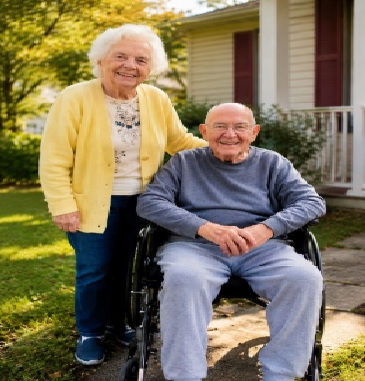
For sixty-one years, I believed there were no secrets left between my husband and me.
When you spend more than six decades beside someone, you assume you have seen every version of them. You know how they take their coffee, which songs make them nostalgic, what stories they tell every Thanksgiving, and exactly how they smile when they are trying to hide good news. You memorize the rhythm of their footsteps, the sound of their laugh from another room, and the silence that means they are worried even when they insist they are fine.
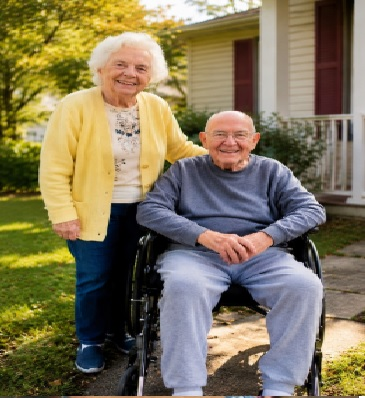
That was how it had always been with Edward.
We met in the summer of 1961.
I was nineteen, working weekends at my aunt’s bookstore. He walked in looking for a travel guide, even though he admitted later that he had no intention of traveling anywhere. He simply wanted an excuse to start a conversation with the girl who smiled at everyone who entered the shop.
Three months later, we were engaged.
One year after that, we were married.
Our life was never glamorous.
Edward worked as a civil engineer for nearly forty years. I taught elementary school until retirement. We raised three children in a modest brick house with a vegetable garden that somehow produced more tomatoes than our family could ever eat.
We argued over wallpaper colors.
We laughed about burnt dinners.
We celebrated promotions, graduations, birthdays, and anniversaries.
We buried our parents.
We welcomed grandchildren.
We held each other’s hands through illnesses, disappointments, and joyful surprises.
If anyone had asked me whether I knew my husband completely, I would have answered without hesitation.
Yes.
Absolutely.
Then he died.
Peacefully.
Quietly.
On a rainy Thursday morning in early autumn.
The funeral was beautiful in the understated way Edward would have appreciated. Friends shared stories about his generosity. Former coworkers praised his integrity. Neighbors remembered the countless weekends he spent repairing fences, shoveling snow, or helping with home repairs without accepting payment.
Everyone described the man I thought I knew.
After the service, our children stayed with me for several days before returning to their own families.
The house became painfully quiet.
His reading glasses still rested beside his favorite chair.
His gardening gloves hung from the hook in the garage.
His old wristwatch remained on the bedroom dresser, frozen at the exact time it had stopped years earlier after he replaced it with a newer one but refused to throw it away.
Every room carried echoes of him.
Exactly one week after the funeral, another reminder arrived.
The mail carrier handed me a cream-colored envelope addressed in elegant handwriting.
No return address.
Only my name.
Inside was a single sheet of paper.
It began with a sentence that stole the air from my lungs.
You never knew his other life.
I read the words again.
And again.
The letter continued.
If you are reading this, then Edward is gone, and it is finally time for you to learn about a promise he made more than fifty years ago. Please do not mistake what follows for betrayal. He kept this secret because someone else’s future depended on it.
The letter was signed only with the name:
Margaret.
I had never heard Edward mention a Margaret.
Not once.
My hands trembled as I folded the paper back into its envelope.
Every terrible possibility rushed into my mind.
Another family?
A hidden child?
A life built on lies?
For the first time since losing my husband, grief was joined by confusion.
Two days later, another envelope arrived.
This one contained only an address and a note.
Please come. You deserve the truth.
Against every instinct telling me to ignore it, I drove there.
The address belonged to a small community library nearly two hours away.
Inside, an elderly woman waited by the window.
She recognized me immediately.
“You’re Helen.”
“And you’re Margaret?”
She nodded.
For several moments neither of us spoke.
Finally she gestured toward a table where old photographs and folders had been carefully arranged.
“I suppose you believe your husband lived a double life.”
“I don’t know what to believe.”
She smiled sadly.
“He didn’t.”
She handed me a faded black-and-white photograph.
It showed a young Edward standing beside a teenage girl in a hospital room.
The girl couldn’t have been older than fifteen.
Her left leg was heavily bandaged.
“That’s my sister,” Margaret explained.
“Her name was Eleanor.”
I waited.
“In 1968,” Margaret continued, “our parents died within six months of each other.”
“We were left with nothing.”
“I was twenty.”
“Eleanor was fifteen.”
“Medical bills consumed everything.”
She opened another folder.
“Our landlord planned to evict us.”
“We had nowhere to go.”
She looked directly at me.
“Edward was the engineer supervising repairs on the apartment building next door.”
“He overheard our conversation.”
“That afternoon he quietly asked whether we needed help.”
I frowned.
“He never told me.”
“He promised he never would.”
Margaret reached into another folder and removed dozens of canceled checks.
Every one bore Edward’s signature.
Month after month.
Year after year.
Small amounts.
Never extravagant.
Enough to cover rent.
Enough for medicine.
Enough for school supplies.
Enough to keep two frightened sisters together.
“He supported you?”
“For fourteen years.”
I stared at the documents.
“Why would he hide that from me?”
“Because you had two young children.”
“Because money was tight.”
“Because he never wanted you to feel guilty wondering whether your family had sacrificed for ours.”
The room fell silent.
Margaret continued.
“When Eleanor finished college, she became a pediatric nurse.”
“I became a librarian.”
“We tried to repay every dollar.”
“He refused.”
Instead, Edward gave them one condition.
“If you ever wish to thank me,” he had said, “help someone else when you are able.”
Margaret smiled through tears.
“So we did.”
She opened the final folder.
Inside were photographs.
Children receiving scholarships.
Families moving into emergency housing.
Food pantry volunteers.
Free literacy classes.
Medical equipment donations.
For decades, Margaret and Eleanor had quietly continued the chain of kindness Edward began.
Not under his name.
Never seeking recognition.
Simply helping.
One life at a time.
“There’s more,” Margaret whispered.
She handed me a notebook.
The first page read:
Lives Changed.
Inside were handwritten entries spanning fifty years.
Each page told another story.
A widowed father who found temporary housing.
A teenager who became the first in her family to attend university.
A refugee family furnished with household essentials.
A veteran whose wheelchair ramp was built by volunteers.
Hundreds of names.
Hundreds of lives.
At the very end appeared Edward’s handwriting.
“Kindness grows best when no one is trying to take credit for planting it.”
I closed the notebook slowly.
Suddenly, memories began connecting in ways they never had before.
The weekends he claimed to be helping former coworkers.
The evenings he arrived home late, saying only that someone had needed assistance.
The occasional cash withdrawals that seemed too small to question.
None of it had been suspicious.
He simply never explained.
Not because he doubted me.
Because he had promised.
And because breaking someone else’s confidence would have betrayed the very trust that made his help meaningful.
Before I left, Margaret handed me one final envelope.
“He wanted you to have this after he was gone.”
The letter inside was unmistakably Edward’s.
My dearest Helen,
If you are reading this, then Margaret has finally broken the silence I asked her to keep.
I know this revelation may hurt at first.
Please understand that I never kept this part of my life from you because I loved you less.
I kept it private because generosity changes when it becomes performance.
The greatest acts of kindness are often the quietest ones.
You once told me that love is measured by what we consistently choose.
You were right.
Every day I chose you.
Every evening I came home to the life we built together because it was always my greatest blessing.
Helping others never competed with loving you.
It simply became another way of honoring the compassion you taught me by the example of your own life.
If you wish to honor my memory, don’t remember me for what I secretly gave.
Remember me for the family we openly built together.
By the time I reached the final sentence, I could barely see through my tears.
Months later, I returned to the library.
Not to uncover more secrets.
But to volunteer.
Margaret and I became unlikely friends.
Together we continued the scholarship fund that Eleanor had established before her passing several years earlier.
We added another program that helped elderly widows repair their homes without charge.
No buildings were named after Edward.
No plaques carried his photograph.
No ceremonies celebrated him.
Just as he would have wanted.
People sometimes ask whether discovering his hidden life changed the way I remembered my husband.
The answer is yes.
But not because I realized I had known him less than I believed.
Rather, I realized that love is too vast for any one person to witness completely.
Even after sixty-one years of marriage, there are parts of a generous heart that exist quietly beyond the spotlight—not because they are meant to deceive, but because they are meant to serve.
I thought I had known everything about Edward.
In truth, I had known everything that mattered to our life together.
The letter did not reveal another man.
It revealed a deeper version of the one I had loved all along.
And in the years since his passing, I have come to understand that perhaps the greatest legacy anyone can leave behind is not a fortune, a title, or a monument.
It is a chain of unseen kindness that continues long after their own story has come to an end, touching lives they will never meet and inspiring compassion in people they will never know.