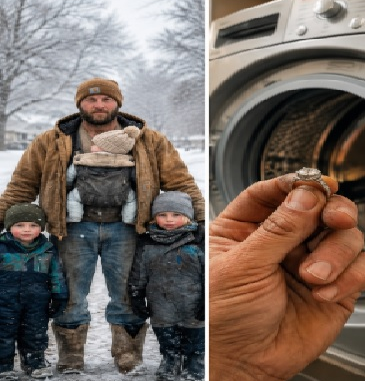
I’m thirty-one years old. My name is Daniel, and I’m raising my three children on my own. People always say that becoming a single parent teaches you what truly matters.
I used to think those words were something people said to make difficult situations sound meaningful.
Now I know they’re true.
Not because life suddenly becomes easier.
It doesn’t.
Not because every struggle magically turns into a lesson.
It won’t.
But because one ordinary day after another slowly strips away everything that never really mattered in the first place.
Five years ago, my life looked completely different.
I had a steady job as a construction supervisor, a small house in the suburbs, and a wife I believed I would grow old beside. We weren’t wealthy, but we were comfortable. Friday nights meant homemade pizza and movies on the living room floor. Saturdays were spent at soccer games, grocery shopping, and arguing over which flowers to plant in the front yard.
Life wasn’t perfect.
It was simply ours.
Then everything changed.
My wife, Emily, became seriously ill.
At first, everyone thought it was just exhaustion. She had always pushed herself too hard, balancing work, parenting, and caring for everyone around her. But weeks turned into months, and her strength disappeared little by little.
Doctors searched for answers.
Specialists ran test after test.
Eventually, we received a diagnosis that changed every plan we had ever made.
For two years, we fought together.
Some days gave us hope.
Others stole it away.
Through every hospital visit, every sleepless night, and every whispered promise that tomorrow would be better, Emily worried about only one thing.
The children.
Not herself.
Never herself.
“If something happens to me,” she once said quietly, “promise me they’ll always know how loved they are.”
I refused to hear those words.
I believed love alone could keep people alive.
I was wrong.
The morning she passed away remains frozen in my memory.
The hospital room was silent except for the steady rain tapping against the windows.
She squeezed my hand one final time.
Then she was gone.
When I drove home, I sat in the driveway for nearly an hour because I couldn’t figure out how to walk inside and tell our children that the person who made our family feel complete would never come home again.
Our oldest, Mason, was ten.
He tried to be brave.
Too brave.
He stopped crying after the funeral because he believed someone had to “be the man of the house.”
Our daughter, Ava, who had just turned seven, asked every night whether Heaven had bedtime stories.
Our youngest, Noah, was only three.
For months he waited by the front window every evening.
“Mommy’s late again,” he would say.
No explanation ever seemed enough.
The first year felt impossible.
Every routine became a mountain.
Packing lunches.
Braiding Ava’s hair.
Helping with homework.
Remembering dentist appointments.
Paying bills.
Fixing leaking faucets.
Reading bedtime stories even when exhaustion made the words blur together.
I failed often.
I burned dinners.
Forgot school picture day.
Mixed up soccer schedules.
Once I accidentally packed frozen waffles into Mason’s lunchbox without cooking them.
When he came home, I apologized over and over.
He smiled.
“They weren’t that bad.”
We both knew they were terrible.
We laughed until we cried.
Sometimes those two things happened together.
Money became tight.
Very tight.
Medical bills had drained our savings.
I sold my motorcycle.
Then my fishing boat.
Then the expensive watch my grandfather had left me.
Every sale hurt.
But every sacrifice bought us a little more time.
At night, after the children had gone to bed, I often sat alone in the kitchen wondering whether I was enough.
Could one parent really fill the space left by two?
The answer always felt like no.
Still, morning always came.
And children don’t stop needing breakfast simply because their father feels overwhelmed.
So I got up.
Again.
One snowy December afternoon, I picked the kids up from school expecting the usual chorus of stories about spelling tests and playground adventures.
Instead, Mason climbed into the truck carrying a cardboard box.
“What’s that?” I asked.
“Our class project.”
Inside were dozens of handwritten notes.
His classmates had each written something they admired about another student.
Mason’s note read:
“He always helps everyone, even when he’s sad.”
Another:
“He shares his lunch when someone forgets theirs.”
Another:
“He’s really good at making people laugh.”
I glanced at him.
“You never told me this.”
He shrugged.
“It doesn’t seem important.”
But it was.
Because I suddenly realized something.
Children don’t become kind because life is easy.
They become kind because someone chooses kindness when life isn’t.
Months passed.
Little victories began replacing constant survival.
Ava learned to braid her own hair.
Noah finally stopped waiting at the window.
Mason started helping his younger siblings with homework without being asked.
Our house wasn’t quieter.
It wasn’t cleaner.
It certainly wasn’t more organized.
But somehow it became stronger.
Not because tragedy disappeared.
Because we learned to carry it together.
One Saturday morning, I found Ava standing in the garage staring at my old toolbox.
“What are you doing?”
“I’m fixing my bike.”
“Do you know how?”
“No.”
“Then why not ask me?”
She smiled.
“Because I wanted to try first.”
She failed.
Repeatedly.
Then succeeded.
Watching her reminded me of something I had forgotten.
Courage isn’t the absence of difficulty.
It’s deciding difficulty isn’t the end of the story.
The biggest surprise came on my thirty-first birthday.
I hadn’t planned anything.
Birthdays felt different now.
The children disappeared upstairs after dinner, whispering loudly enough for me to hear every word.
Twenty minutes later they called me into the living room.
The coffee table was covered with handmade decorations.
Construction paper banners.
Crayon drawings.
Three cupcakes.
Not a cake.
Just three cupcakes.
“We made them ourselves,” Noah announced proudly.
One was slightly burned.
One leaned sideways.
One had far too much frosting.
“They’re perfect,” I said.
Mason handed me a small envelope.
Inside was a folded piece of notebook paper.
Across the top they had written together:
“Things Dad Doesn’t Know.”
The list continued.
“You always pretend you’re not tired.”
“You eat the broken cookies so we can have the nice ones.”
“You think we don’t notice when you skip buying things for yourself.”
“You still talk to Mom when nobody’s listening.”
I stopped reading.
My vision blurred.
Ava hugged me tightly.
“We notice everything.”
That sentence stayed with me.
Parents spend years worrying about teaching their children.
Sometimes we forget they are quietly teaching us too.
Today our life still isn’t perfect.
The laundry still piles up.
The dishes still seem endless.
Someone always loses a shoe five minutes before leaving the house.
Bills still arrive.
The roof still leaks whenever it rains hard enough.
Some evenings I still miss Emily so much that breathing feels heavier than it should.
But our home is also filled with laughter.
Movie nights.
Pancake breakfasts on Saturdays.
Dance parties in the kitchen while dinner cooks.
Bad jokes that somehow become family traditions.
The grief never disappeared.
It simply learned to live beside love instead of replacing it.
People often tell me they don’t know how I manage to raise three children alone.
The truth is, I don’t.
We raise one another.
Mason reminds me to be patient.
Ava reminds me to stay curious.
Noah reminds me that joy often arrives in the smallest moments.
Together we’ve built a family that doesn’t pretend life has been fair.
Instead, we’ve chosen to believe that difficult beginnings don’t have to decide beautiful endings.
If becoming a single parent has taught me anything, it is this:
Children don’t remember whether the house was spotless.
They don’t remember expensive vacations or perfect birthday parties.
They remember who showed up.
Who listened.
Who stayed.
Who kept loving them even on the hardest days.
Every night before bed, I still repeat the promise I made to Emily years ago.
“They’ll always know how loved they are.”
Some days I keep that promise flawlessly.
Other days I stumble.
But every morning I get another chance.
And as long as my children know they are loved beyond measure, I believe we’re already richer than we ever imagined.
Because in the end, the strongest families are not the ones who never face heartbreak. They are the ones who choose, day after day, to keep building a home where hope has a place at the table, laughter echoes through the hallways, and love remains the one thing that never runs out.